Kathleen C. Minor
With my M.A. in political communication from Johns Hopkins University and a passion for creating change, I’m actively seeking meaningful work at the coalescence of social justice and communication.
In 2008 I got my start in politics training phone bank volunteers for Obama for America in what would later become Marjorie Taylor Greene’s congressional district. In 2012 I cast my first ballot for Obama. I realize my own naïvete now, but back then I believed the world had changed. It took 2020 for me to recognize that I could no longer, in good conscience, pursue the career in creative writing for which I had spent 20 years preparing.
The Deep South had grown crimson with deaths from Covid-19. Friends and family I had known since birth had turned on me. My father had been a physician in Northwest Georgia for 30 years, and yet patients who had seen him for decades were suddenly questioning his medical expertise. My brother, in medical school, had to suddenly worry if his industry would exist by the time he graduated. At the same time I realized I was asexual, many of my family members in Florida were voting for Don’t-Say-Gay legislation, further dooming young people to question, as I had for so many years, if something was wrong with them. All of this at a time when our planet burned and leaders rejected the very existence of climate change. Getting my M.F.A. in creative writing by then felt frivolous, but politics felt suffocating, existential, and frankly, terrifying.
Then John Lewis, the last of the Big Six leaders of the Civil Rights Movement, died. Lewis had long been an icon, but an inhuman one. As I watched Barack Obama take the stage at Lewis’s funeral, I expected a eulogy for a superhero, wondering in the back of my head who would lead us with Georgia’s biggest leader gone. But as Obama spoke, for one of the first times since he had left office, he told the story of a very ordinary kid from Troy, Alabama, short and scrappy, who simply refused to give up. America, Obama reminded me as I sat in my parents’ kitchen, ears peaked because I myself only measure 4’8”, had never been a comic book: we never had superheroes. It had always come down to the most ordinary people.
It was the moment that changed my life. As Obama continued to speak I signed up for my first phone bank shift since 2008. I joined the Democratic Party of Georgia (DPG) at a time when no one in the country believed our state could matter, but in 2008 no one in a post-9/11 America had believed in Barack Hussein Obama either.
Two weeks into volunteering I was chosen by the staff to work as a volunteer leader and text moderator where I had the most awe-inspiring conversations with voters across Georgia. I spoke with a son desperate for help getting his mother’s absentee ballot to her before she died of cancer. I helped a man in South Georgia get to the polls minutes before they closed on election night. I gave inspirational speeches to far too many across our state who had lost hope that their votes could matter in Georgia. Many of the latter thought I was crazy, and they had every right to: even on election day, Texas was more likely to turn blue than Georgia.
By the end of the week however, John Legend was singing “Georgia On My Mind” to his Twitter followers and every news outlet in the country was talking about us, not just for the Presidential election, but because control of the Senate had come down to a bunch of scrappy volunteers who refused to give up.
After winning two more impossible elections and sending Raphael Warnock and Jon Ossoff to the Senate (John Lewis’s pastor and his intern, respectively) I moved into local politics in Marjorie Taylor Greene’s congressional district, where I faced the same hopelessness I had faced myself only a few months earlier. So I fought back with every tool I had until the hope became contagious. I worked with Democratic county committees to develop new outreach strategies in a district made primarily of Republicans, and taught local volunteers to trade the divisive, technical, and over-complex language of politics for the real-world application of candidates’ policies. Together, we achieved a nearly 10-point shift to the left from 2020-2022.
Combined, this work earned me a spot in Time Magazine in 2020 and the keynote address at the 2022 Kennedy/Carter Dinner in Dalton, Georgia alongside Democratic candidates Bee Nguyen for Georgia Secretary of State, Marcus Flowers for the U.S. House of Representatives, and William Boddie Jr. for Georgia Labor Commissioner.
Though my future in politics is so much more daunting than I had expected it to be post-graduation, I meet this next chapter with relentless hope and a refusal to stay silent.
When every voice is raised, no one can drown us out.
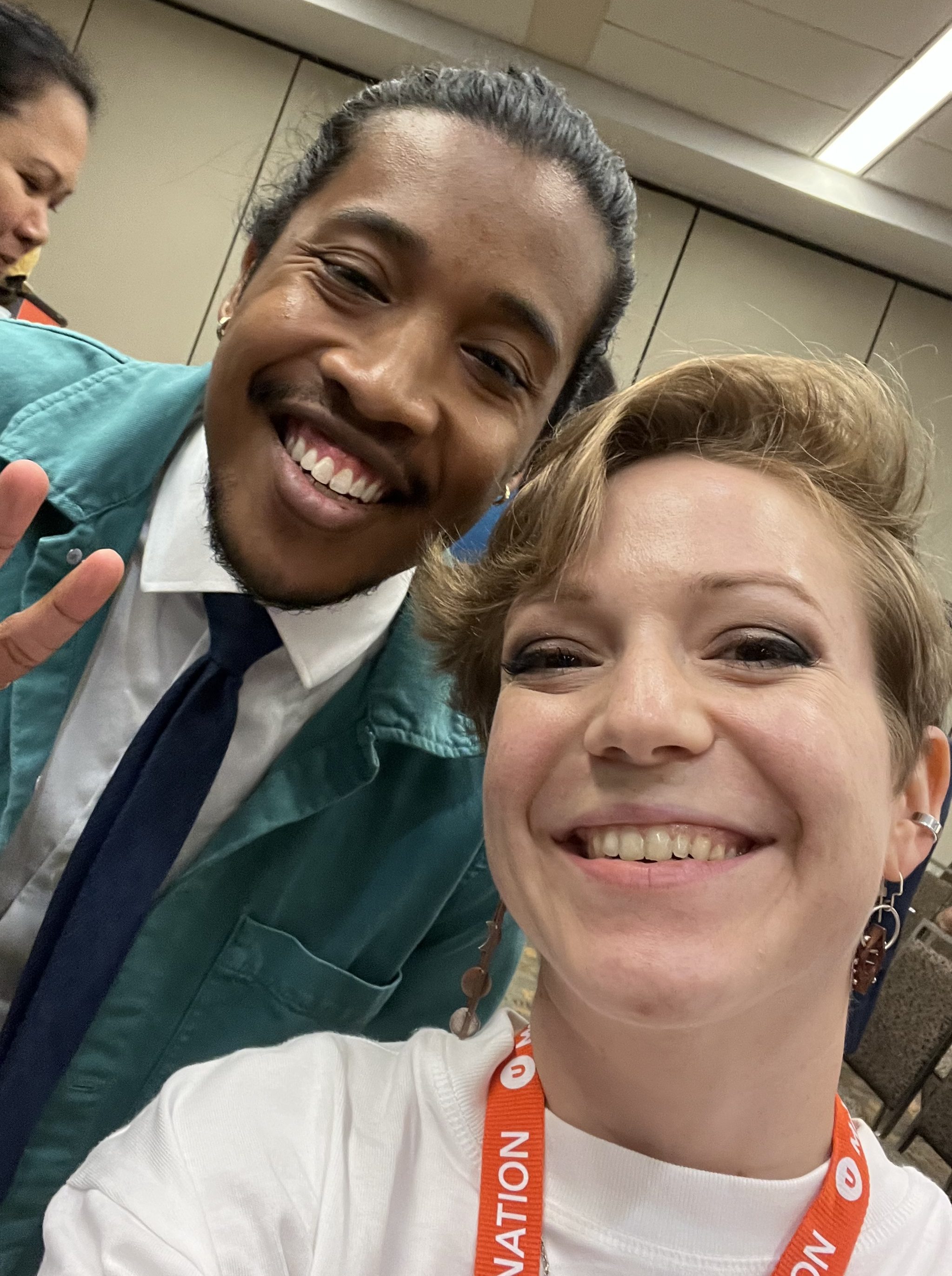
With Justin Jones of the Tennessee Legislature at Netroots Nation in 2024.
 Your Voice Is A Weapon